How to price second-hand clothes on Vinted and Depop
By Lewis Ludlam · · Facts checked
We make SaleLinx, the crosslisting extension, so read our product mentions with that in mind.
Price a used item from what it actually sold for, list a little above that to leave room for offers, and decide your lowest price before you list.
- Search the item and note what sold, not what is listed.
- Vinted’s own guide suggests 60% to 80% of retail for new or like-new, 40% to 60% for very good, and 20% to 40% for good.
- Add 10% to 15% on top for offers.
- Never accept below your floor: cost, plus postage and packaging you cover, plus the least profit worth your time.
Step 1: Find what sold
Asking prices show what sellers hope for, and many have sat unsold for months. You want the price at which the item left.
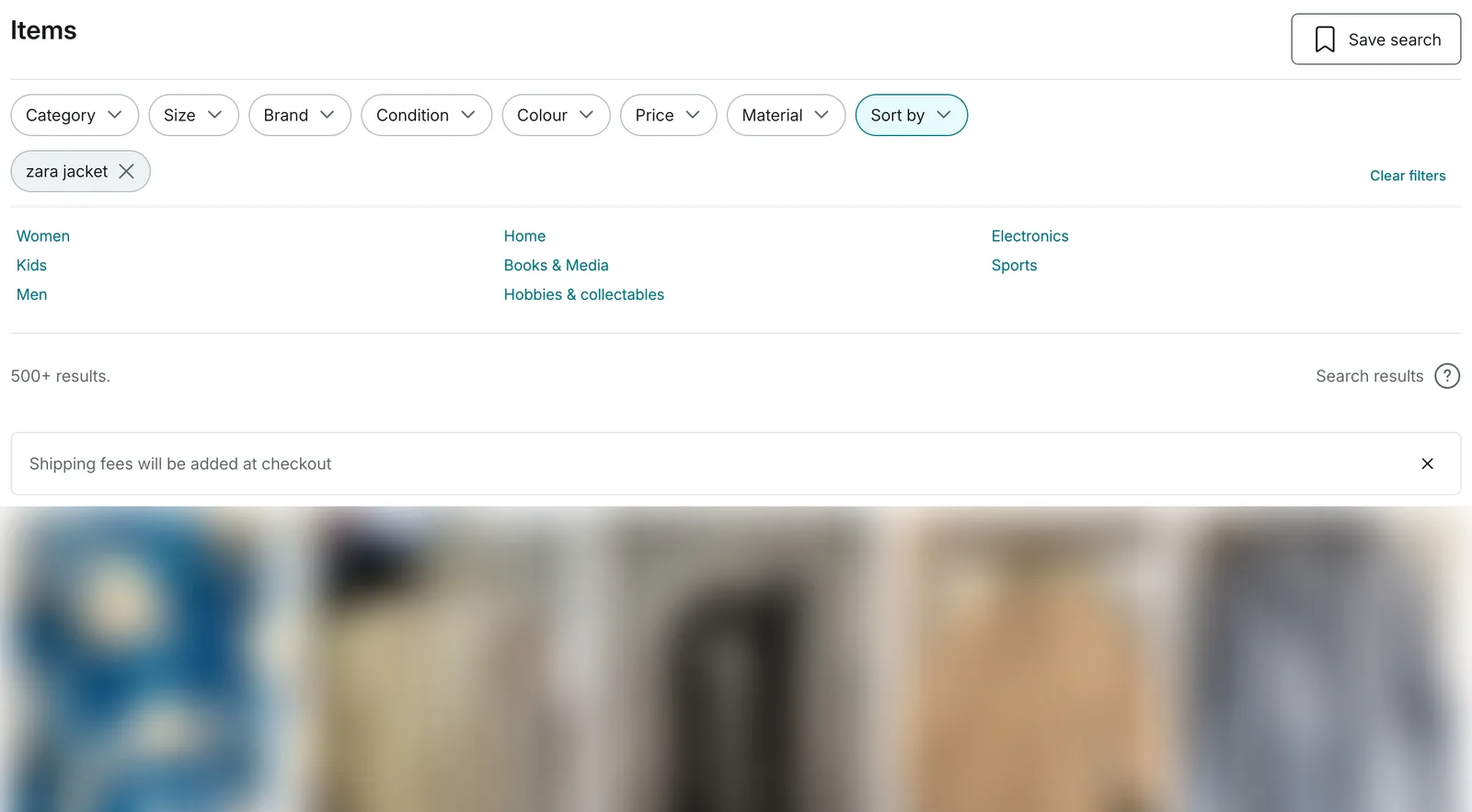
- Vinted: there is no sold filter in search. Vinted’s pricing guide says to “search the catalogue for similar items to see how other members price them”. Search the brand and item, filter to your size and condition, and sort by price. Then open a few wardrobes of sellers with the same item: sold listings stay visible, marked Sold, with their final list price.
- Depop: sold items show in search with a Sold label, so one search with condition and size filters shows asking and sold prices side by side. Ignore the asking ones.
- eBay: even if you do not sell there, the sold items filter is the fastest sold-price check for branded clothes. A Carhartt jacket sells for roughly the same money on all three.
Three or four sold listings give a real range. Write down the lowest, typical and highest sold price. Your item sits on that line according to its condition and your photos.
Step 2: List with room for offers
Both marketplaces are built around offers, so the list price is an opening position.
- Vinted: the offers page says a buyer can offer up to 40% below the listed price and send up to 25 offers a day. Sellers can offer the same 40% the other way, and offers are not binding on either side.
- Depop: buyers have a Make Offer button next to Buy, and sellers can send offers to likers.
List 10% to 15% above the typical sold price. A buyer who offers 15% off lands on the sold price and feels like they won. If someone pays full price, better still.
Do not push it to 40% above. Buyers filter out clearly high prices, and Vinted’s page on how it ranks items lists price among the “item attractiveness” signals, saying the parameter “aims to recommend better deals to members”. An overpriced listing is shown less, not just skipped more.
Step 3: Know your floor
The floor is the lowest price that still makes the sale worth doing. Work it out once, before you list, so you do not have to think about it when an offer lands at 9pm.
- What the item cost you: for your own old clothes this is zero, and sunk cost is not a reason to hold out. For stock you bought to sell, it is the purchase price.
- Postage and packaging you pay for: on Vinted the buyer pays postage, so this is only the mailer bag. On Depop, if you offer free postage, it is the label too.
- Payment fees: Vinted charges sellers nothing. Depop’s seller fees page says there is no selling fee for UK sellers, but payment processing is 2.9% plus £0.30 on the item, postage and any tax.
- The least profit worth your time: photographing, listing, packing and posting takes 15 to 20 minutes. If £2 is not enough for that, say so now.
Anything below the floor is a no, however nicely the buyer asks.
What percent of retail?
When there are no sold comparables, because the item is unusual or the brand is small, work from the retail price. Vinted’s pricing guide publishes bands by condition, and we have added a brand adjustment from experience.
- Vinted guide
- 60% to 80%
- High street (Zara, H&M, Next)
- 40% to 50%
- Mid brands (Nike, Levi's, Carhartt)
- 55% to 70%
- Designer and sought-after vintage
- 60% to 80%
- Vinted guide
- 40% to 60%
- High street (Zara, H&M, Next)
- 25% to 35%
- Mid brands (Nike, Levi's, Carhartt)
- 40% to 50%
- Designer and sought-after vintage
- 45% to 60%
- Vinted guide
- 20% to 40%
- High street (Zara, H&M, Next)
- 15% to 25%
- Mid brands (Nike, Levi's, Carhartt)
- 25% to 35%
- Designer and sought-after vintage
- 30% to 45%
- Vinted guide
- 20% to 40%
- High street (Zara, H&M, Next)
- Bundle it
- Mid brands (Nike, Levi's, Carhartt)
- 15% to 25%
- Designer and sought-after vintage
- 20% to 35%
| Condition | Vinted guide | High street (Zara, H&M, Next) | Mid brands (Nike, Levi's, Carhartt) | Designer and sought-after vintage |
|---|---|---|---|---|
| New with tags or like new | 60% to 80% | 40% to 50% | 55% to 70% | 60% to 80% |
| Very good | 40% to 60% | 25% to 35% | 40% to 50% | 45% to 60% |
| Good | 20% to 40% | 15% to 25% | 25% to 35% | 30% to 45% |
| Satisfactory (visible wear) | 20% to 40% | Bundle it | 15% to 25% | 20% to 35% |
Two things move an item within its band:
- Photos: daylight on a plain background sells higher than the same item on a bed, at the same condition.
- Completeness: original tags, box or dust bag, and a clear size label push you to the top of the range.
What does the buyer pay?
Your price is not the number the buyer sees at checkout. Both marketplaces add a fee on the buyer’s side.
- Vinted: the Vinted fee, which its price list (last updated 8 October 2026) puts at “usually 3% to 8% + £0.3 to £0.8” of the item or bundle price, plus postage. You receive your full list price.
- Depop: a Marketplace fee of up to 5% of the item price plus up to £1, shown at checkout. You receive the list price minus the 2.9% plus £0.30 processing fee.
So a £28 jacket costs a Vinted buyer roughly £30 before postage and a Depop buyer up to £30.40, and on Depop you keep about £26.89.
The same list price is slightly less attractive on Depop and pays you slightly less, so price Depop a pound or two higher where the audience supports it. Our Depop or Vinted guide covers what each audience will pay.
Round numbers, not £9.99
Price in whole pounds. Buyers filter by a price range they type in, and they type round numbers: up to £10, £15 to £25. A £10 item is inside “up to £10”, a £10.50 item is not, and £9.99 buys you nothing over £10 while looking like a shop.
Sit on the band edge buyers are likely to type, not just over it: £20, not £22. £15, not £16. The exception is a deliberately low opener for a cheap item you want gone, where £4 reads as a bargain and £5 reads as a price.
How to price bundles
Bundles are where cheap items make sense. A £3 top is not worth posting alone, but five at £12 is.
- Vinted: set a bundle discount in your settings. It applies automatically when a buyer picks several items from your wardrobe.
- Depop: agree a bundle price in a message and send an offer for it.
Price the bundle so each item lands at or just under what it would fetch alone. The buyer is saving on postage and the fixed part of the fee, which is their real reason to bundle.
When to lower the price
A price is a guess until the listing has been seen. Two weeks is long enough to know.
- Views but no likes: people find it and do not want it, so it is the photos or the price. Retake the first photo in daylight, then drop the price by about 10%. Vinted’s pricing page says a price “lower than our catalogue average price might help you sell faster”, and a drop also notifies anyone who has favourited the item.
- Likes but no sale: the price is close. Send the likers an offer at 10% to 15% off instead of cutting it for everyone. Our guide to sending offers has the steps and the maths.
- Hardly any views: the listing is buried or the title is wrong. Check the title has brand, item, colour and size, then relist once with better photos (our relisting guide covers Vinted’s rules) or try the other marketplace.
Drop in steps of about 10% every week or two, never one 40% cut, and stop at your floor. At the floor with no sale, bundle the item or move on.
Season changes the price
The same coat is worth more in October than in March. Vinted’s pricing page says to “keep seasonality in mind”.
List seasonal items four to six weeks before the season at the top of the sold range, then accept that anything left when the season ends goes at the bottom of it or waits a year. Our guide to the best time to post on Vinted covers timing within the week.
A worked example
A Zara wool-blend jacket, bought for £60 two winters ago, worn a dozen times, no marks. Very good condition.
- Sold comparables. Vinted wardrobes show the same jacket sold at £20, £22, £25 and £28. Depop search shows two sold at £25 and £30. Typical: about £25.
- Check against retail. Vinted’s very good band is 40% to 60% of £60, so £24 to £36. The high street column in our table says £15 to £21. The sold prices sit between the two, which is normal for a current-season style. Trust the sold prices.
- List price. £25 plus 10% to 15% is £27.50 to £28.75. List at £28 on Vinted. On Depop, where the buyer fee is higher and the audience pays for the look, £30.
- Floor. The jacket cost nothing now, the mailer is £0.50, and £15 is the least you would post it for. Floor: £18 on Vinted. On Depop, add the £1.17 processing fee and a free-postage label if you offer one.
- What the buyer sees. On Vinted, £28 plus a fee of roughly £2 plus postage. On Depop, £30 plus up to £2.50.
- After two weeks. Three likes, no sale: send each liker an offer at £24. One accepts. You got the typical sold price, and the buyer got a discount.
 How SaleLinx helps
SaleLinx is a Chrome extension for Depop, Vinted and eBay sellers. Most of the method above is reading views and likes, then acting on them.
- My Listings shows every Depop, Vinted and eBay listing in one grid with price, views and likes, so the two-week check is one sort.
- The Dead Stock tab scores each listing by age, views and likes, so items that need a price change surface on their own.
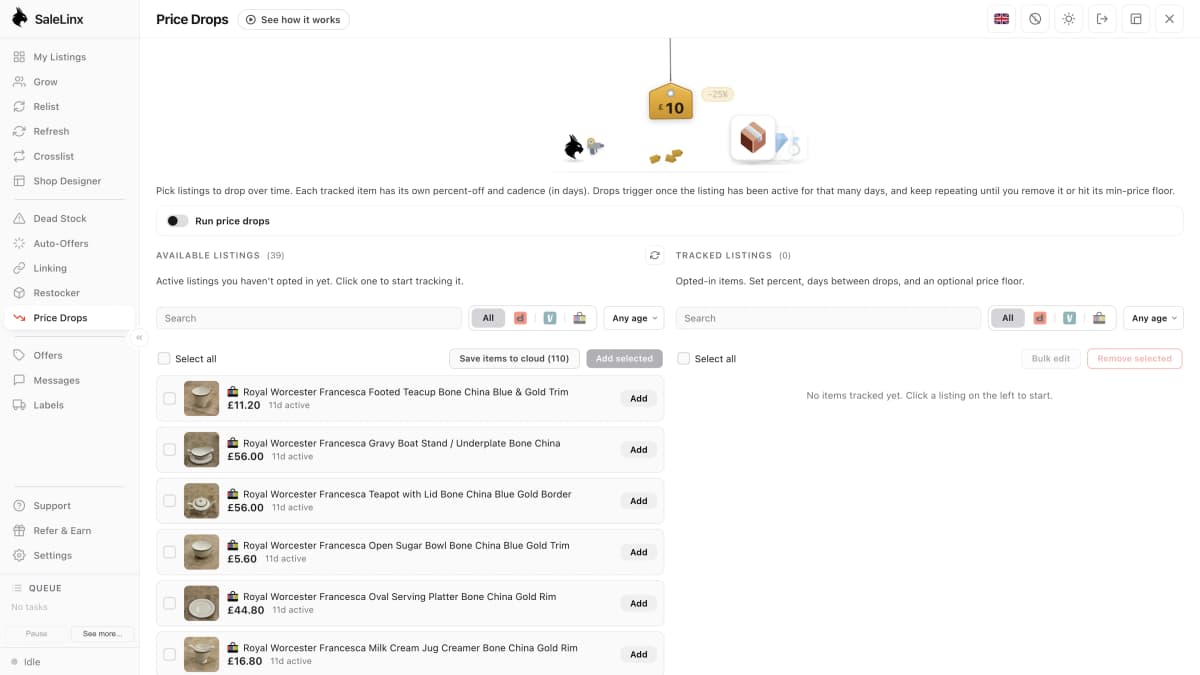
- Scheduled price drops apply the 10% steps on a timetable, per item, with a floor they never go below. The price drops guide shows the settings.
- The Auto-Offers tab sends Vinted likers an offer instead of cutting the public price.
Vinted’s terms restrict external software tools, so keep whatever you do there to the pace of a person editing by hand. From £7.99 a month, with a 14-day free trial.
Try it free for 14 daysQuestions
How much should I price used clothes at?
Start from what the same item has sold for, then list 10% to 15% above the typical sold price to leave room for offers. If there are no sold comparables, Vinted’s own guide suggests 60% to 80% of retail for new or like-new, 40% to 60% for very good and 20% to 40% for good condition. High street brands sit at the lower end and sought-after brands at the upper.
Should I price higher to leave room for offers?
A little. Buyers on Vinted can offer up to 40% off and most open at 10% to 20%, so listing 10% to 15% above your target means a normal offer lands on it. Do not list 30% to 40% above, because buyers filter by price and Vinted ranks on it, so an obviously high price is seen less.
Does Vinted take a cut of my price?
No. Vinted charges sellers nothing, and the buyer pays the Vinted fee, usually 3% to 8% plus £0.30 to £0.80, on top of your price. Depop charges UK sellers 2.9% plus £0.30 in payment processing, and the buyer pays a Marketplace fee of up to 5% plus up to £1.
Is it better to price at £9.99 or £10?
£10. Buyers on these apps filter by whole-pound ranges, and the .99 saves them a penny while making you look like a shop. Price in whole pounds and sit on the edge of the band buyers are likely to type.
When should I drop the price?
After about two weeks without a sale, and only if the item is getting views but no likes. If it has likes, send those people an offer instead. Drop in steps of about 10%, a week or two apart, and stop at your floor.