eBay item specifics: what they are and why listings get refused
By Matt Valetsky · · Facts checked
We make SaleLinx, the crosslisting extension, so read our product mentions with that in mind.
Item specifics are the structured fields on an eBay listing, such as brand, size, colour, department and type. A listing missing a required one will not go live.
- A listing is refused when a required specific is empty or has a made-up value.
- For UK clothing that is almost always Brand, Size, Colour, Department or Type.
- The sell form marks every required field. Fill those first, and pick eBay’s suggested value rather than typing your own.
- For listings already up, use Seller Hub’s missing specifics filter.
What are item specifics?
They are separate from the title and description, and they are the only part of a listing that eBay’s search filters can read. eBay’s Seller Centre describes them as fields that “may include brand, size, type, colour, style or other relevant info about the item you’re selling”.
Each one is a name and a value: Brand is the name, Nike is the value. The names depend on the category. Trainers get UK Shoe Size and Upper Material; a dress gets Dress Length and Sleeve Length.
eBay does not read your description the way a buyer does. Its filters, category pages and a lot of its search ranking work from these fields. Write “size 12 black Zara dress” in the title and leave Size empty, and a buyer who ticks Size 12 will never see it.
Required, recommended or additional?
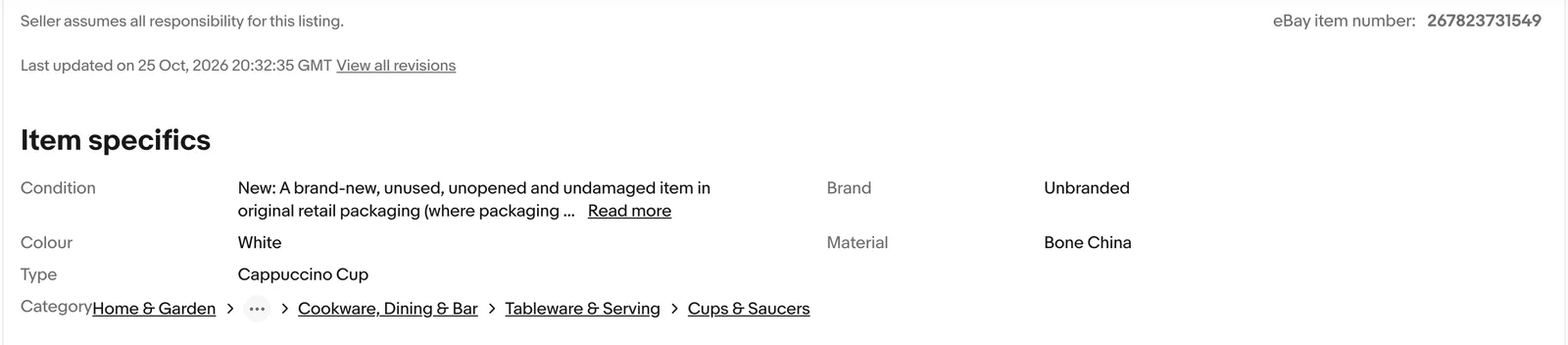
eBay sorts the specifics for every category into three groups. The difference decides whether your listing goes live.
- Required: the Seller Centre says “New or revised listings that don’t include required item specifics will be blocked.” They have a mark in the sell form. Brand, Size and Colour are eBay’s examples of what is “critical to the buyer experience”.
- Recommended: not needed to list, but eBay says they “improve your potential buyers’ search experience”. They feed the filters and category pages, so a listing without them is live but easy to miss.
- Additional: everything else eBay offers for the category. Optional.
There is also a fourth label, Required soon. eBay adds new required specifics a few times a year and flags them in the sell form with the date they become mandatory.
Its April 2022 notice is a typical example: new fields appeared in May and became required in July. A listing that was fine when you wrote it can need a new field the next time you revise it.
Why does eBay refuse a listing?
eBay blocks a listing when you save it. The message is nearly always one of these four:
- A required specific is empty. The most common by far. The sell form highlights the field and will not let you continue.
- The value is not one eBay recognises. You can type a custom value in many fields, but for some, Size above all, eBay now only accepts its own list. Its listing help says that from August 2026 apparel and footwear listings with “unclear or missing size or condition details may be hidden until updated”, and names “See description” and “N/A” as values it will flag.
- The category is wrong. Each category has its own specifics. List a women’s coat under Men’s Coats and eBay asks for a different Size list and Department, and your values stop matching.
- A placeholder in a required identifier. eBay’s item description policy says “Does not apply”, unbranded or generic, and “N/A” are not allowed in required product identifiers such as EAN or MPN. Second-hand clothes rarely need those, but a category that does can still refuse the listing.
The same policy says the consequences run from “removing the listing” through warnings to “restricting activity or account suspension”. In practice an empty field just stops the listing. A wrong or misleading value on a live listing is what leads to removal.
What is required for clothes and shoes?
The exact set depends on the leaf category, and eBay changes it. The sell form is the only complete list, so trust it over any table. This is what sellers in eBay UK’s Clothes, Shoes and Accessories tree meet most often.
- Usually required
- Brand, Size, Colour, Department, Type
- Usual reason for a refusal
- Size left blank, or typed as "Small" instead of S
- Usually required
- Brand, Size, Colour, Department, Type, Style
- Usual reason for a refusal
- Style empty; Dress Length or Skirt Length missing
- Usually required
- Brand, Size, Colour, Department, Type, Inside Leg or Size Type
- Usual reason for a refusal
- A waist written as "32 34" that eBay cannot read
- Usually required
- Brand, Size, Colour, Department, Type, Style, Outer Shell Material
- Usual reason for a refusal
- Material or Style left empty
- Usually required
- Brand, UK Shoe Size, Colour, Department, Type, Upper Material
- Usual reason for a refusal
- An EU size in the UK size field
- Usually required
- Brand, Colour, Type, Department
- Usual reason for a refusal
- A brand that is not on eBay's list, or Type empty
| Category | Usually required | Usual reason for a refusal |
|---|---|---|
| Tops, jumpers, hoodies | Brand, Size, Colour, Department, Type | Size left blank, or typed as "Small" instead of S |
| Dresses and skirts | Brand, Size, Colour, Department, Type, Style | Style empty; Dress Length or Skirt Length missing |
| Jeans and trousers | Brand, Size, Colour, Department, Type, Inside Leg or Size Type | A waist written as "32 34" that eBay cannot read |
| Coats and jackets | Brand, Size, Colour, Department, Type, Style, Outer Shell Material | Material or Style left empty |
| Shoes and trainers | Brand, UK Shoe Size, Colour, Department, Type, Upper Material | An EU size in the UK size field |
| Bags and accessories | Brand, Colour, Type, Department | A brand that is not on eBay's list, or Type empty |
Two of these catch sellers out again and again:
- Department is not the same as the category. eBay wants Men, Women, Unisex Adult, Boys or Girls as a field, even if the category already says Women’s.
- Size Type (Regular, Petite, Tall, Plus, Maternity) sits next to Size on many clothing categories and is easy to scroll past.
How do I see the required list before I list?
You do not have to guess.
- In the sell form. Pick the category first, then scroll to Item specifics. Required fields sit at the top with a mark, and the dropdown values are eBay’s own list. The Seller Centre advises you to “use eBay’s suggested values as much as possible rather than creating your own custom values”, because a custom value does not match a filter.
- In Seller Hub, for listings already up. The Active listings page has quick filters for listings missing Required, Required soon and Recommended specifics. The Overview tab shows a task reminder when any listing is missing a required one. The Download button offers an Excel file of your listings with their specifics, which you can fill in and upload back.
- In the app. My eBay and the eBay app show which active listings have missing item specifics, according to the Seller Centre.
What do I put when I do not know?
Most refusals come from fields that are hard to fill honestly on second-hand stock: no label, a faded size, a brand you cannot read.
- Brand: if there is no brand, eBay’s list includes Unbranded and Handmade. Pick the one that is true. Do not type the shop you bought it from, or a designer name on an item that only looks like one.
- Size: use the closest supported size. The item description policy says “If an exact size is not available, select the closest supported size option”, and that sellers “must select the size that most accurately matches the manufacturer’s size designation”. Put measurements in the description, not the Size field. “See description” in Size is exactly what eBay has said it will hide from August 2026.
- Colour: pick the dominant colour from the list. Multicoloured is valid for prints.
- Material: read the care label. If there is none, choose the closest from the list, or leave a recommended field empty rather than guess. Only a required field blocks the listing.
- Product identifiers: EAN, UPC and MPN are rarely required for clothes. When they are, the policy bans “Does not apply” and “N/A”. If the item really has no code, check you are in the right category, since a used-clothing category normally does not ask.
A specific must be true. The policy also bans “Including terms in the wrong field” and “Including information that is not specific to that field”, so a Colour of “Black Nike Hoodie M” is a policy breach, not a keyword trick.
How do specifics drive search?
Buyers search, then narrow with the left-hand panel or the mobile filter sheet: Size, Brand, Colour, Condition, Price.
Every one of those filters reads a specific, not the title. The Seller Centre says filling them in “will help to increase your product’s visibility, especially when buyers use the left-hand navigation filters”, and some specifics “can even make your listings more likely to appear in Google Shopping results”.
The same page says eBay ranks which specifics to show you by “buyer demand data which is compiled from searches on the site over the past 30 days”. So the fields near the top of the sell form are the ones buyers are filtering on right now. They are worth filling even when only recommended.
How do I fix the listings I already have?
Some of your live listings may be missing fields that have since become required. They stay live, because the block only applies to new and revised listings, but they are invisible to the filters, and the next time you edit one eBay will stop you until you fill it in.
In Seller Hub, go to Listings, then Active, and use the “Item specifics: required” quick filter. Then either:
- Select the listings and click Edit to add specifics to several at once, or
- Use Download, pick the missing specifics file, fill in the spreadsheet and upload it. This is quicker above about 50 listings.
Whichever route you take, fix Size and Condition first on clothing and footwear. Those are the two eBay has said it may hide listings for. Our eBay fees guide covers what each listing costs once it sells.
Crosslisting from Vinted or Depop
Vinted and Depop have far fewer structured fields than eBay, so a copied listing has gaps eBay refuses.
- Vinted: a brand, a size, a condition and up to two colours.
- Depop: a brand, a size, a condition and a colour.
- Neither has Department, Type, Style, Size Type or Material.
Any crosslisting app deals with this in one of three ways:
- Post what it has and let eBay reject it.
- Ask you for every missing field before it posts.
- Work the missing ones out from the title and category, and ask only for what is left.
Our comparison of crosslisting apps covers how each one handles it.
If you crosslist by hand, do the eBay listing from the sell form with the Vinted tab open beside it, and fill the required block before you touch the description. The description you can copy and paste. The specifics you cannot.
 How SaleLinx helps
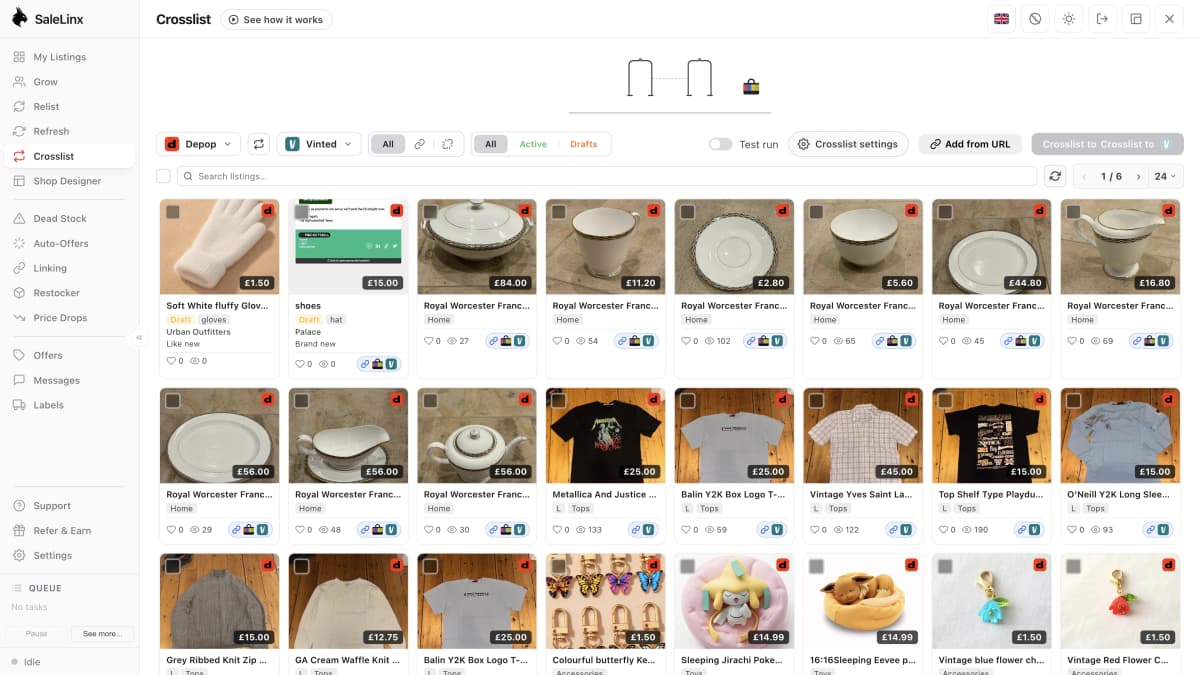
SaleLinx is a Chrome extension for Depop, Vinted and eBay sellers. Its Vinted to eBay and Depop to eBay crosslisters take the third route above.
- They pick the eBay category and fill in brand, colour, size, department and the rest from the source listing.
- They check each item with eBay before anything is posted, and show a Fill in button on any row eBay would still refuse.
- My Listings shows your eBay listings next to your Depop and Vinted stock. Select the eBay ones and click Edit, and each card has the category, condition and item specifics, with Save Changes sending them straight to eBay.
- The eBay bulk editor changes price, title, description and quantity across a selection. Specifics are set per card.
Copies to eBay go live, so that check is the review step. From £7.99 a month, with a 14-day free trial.
Try it free for 14 daysQuestions
What does “missing required item specifics” mean on eBay?
One or more fields that eBay requires for that category is empty, or holds a value eBay does not accept. The listing will not be saved until you fill it in. In the sell form the field is highlighted, and in Seller Hub the listing appears under the Required quick filter.
Which item specifics are required for clothing on eBay UK?
It varies by category, but Brand, Size, Colour, Department and Type are the usual set. Style, Material and a size measurement are added in some categories. Pick the category in the sell form and look at the marked fields, since that list is the current one.
Can I put “Does not apply” in an item specific?
Not in a required product identifier. eBay’s item description policy bans “Does not apply”, “N/A” and unbranded or generic in those fields. For Brand, pick Unbranded from eBay’s list if the item has no brand. For Size, pick the closest supported size and put the measurements in the description.
Do item specifics affect how many people see my listing?
Yes. eBay’s search filters, its category pages and part of its ranking read the specifics rather than the title. A listing with empty specifics is live but drops out of every filtered search, and eBay says complete specifics can also help listings appear in Google Shopping.
Will my old listings be removed if they are missing specifics?
Not for an empty field. The block applies to new and revised listings, so old ones stay live until you edit them. The exception is clothing and footwear with an unclear or missing size or condition, which eBay has said it may hide from August 2026 until updated. Fix those first.
How do I add item specifics to lots of listings at once?
In Seller Hub, filter Active listings by missing required specifics, select them and use Edit. Or download the missing specifics spreadsheet, fill it in and upload it.