Self Assessment for Vinted, Depop and eBay sellers: how to file
By Lewis Ludlam · · Facts checked
We make SaleLinx, the crosslisting extension, so read our product mentions with that in mind.
If your Vinted, Depop or eBay selling counts as trading and brought in more than £1,000 between 6 April 2025 and 5 April 2026, you file a Self Assessment return online by 31 January 2027, and pay any tax by the same day.
- Deadline: 11:59pm on 31 January 2027 for both the online return and the payment. The deadline to register (5 October 2026) has passed, so if you have not, do it now.
- Order of play: register, wait for your UTR, add up sales for the tax year, choose between the £1,000 allowance and your actual costs, file, pay.
- Use the self-employment pages. If turnover is under £90,000 you can use the short version.
- Late is expensive: £100 as soon as the return is late, then more, plus 5% on unpaid tax at 30 days, 6 months and 12 months.
Written by the SaleLinx team. We are not accountants and an accountant has not reviewed this. It is general information, last checked against GOV.UK on 8 November 2026. Check your own situation with HMRC or an accountant, or use HMRC’s online checker.
Do I need to file a Self Assessment return?
Probably only if you are trading and your gross income passed £1,000 in the tax year. That question has its own guides, so here is the short version. Selling your own unwanted things is unlikely to be taxed, but buying or making things to sell at a profit is likely to be trading (GOV.UK). Our guides to tax on Vinted and Depop sales, the trading allowance and what Vinted reports to HMRC cover that line.
This guide assumes you have decided you do. It is about how.
What if I missed the 5 October registration deadline?
Register now. GOV.UK says you had to tell HMRC “by 5 October 2026” if you needed to file for 2025 to 2026, and that “if you tell HMRC after 5 October 2026, you could get a penalty” (register for Self Assessment).
On the deadlines page, GOV.UK says that if you register after 5 October, HMRC will send a letter or email with a different return deadline, “3 months from the date on the letter or email”. The payment deadline does not move: “You must still pay the tax you owe by 11:59pm on 31 January 2027 or you’ll get a penalty.”
How do I get a UTR and an HMRC online account?
Registering gets you a Unique Taxpayer Reference (UTR), which you need to file. GOV.UK says HMRC usually posts it “around 15 days after you register”, and longer if you live overseas (find your UTR). Lost it? Check your Personal Tax Account or the HMRC app, or old letters and returns.
- Start on the registration page. Use the “Start now” button on GOV.UK’s registration page and say you are self-employed.
- Create Government Gateway sign-in details if you do not have them. The filing page says you can make them there, and that you may be asked to prove your identity, usually with a passport or driving licence.
- Wait for the UTR. You cannot file without it. If you registered before but did not file last year, you may need to reactivate your account first, or the return may be delayed.
Register early in future. Filing opens on 6 April after the year ends, and you can save a return and come back to it.
Which parts of the return do I fill in?
The main return plus the self-employment pages. Reselling counts as self-employment income, so those pages are where your turnover and costs go.
- Short version: HMRC’s notes for the short pages say to use them if your turnover was less than £90,000. You can put all your expenses in one box instead of itemising them.
- Full version: for turnover of £90,000 or more, or if one of the other cases in HMRC’s full pages notes applies.
A side seller will nearly always be on the short version. If you also have a job, savings interest or other income, the main return has pages for those too.
How do I work out my turnover from Vinted, Depop and eBay?
Add up what buyers paid you for items sold between 6 April 2025 and 5 April 2026, across every platform. That is your turnover, and GOV.UK defines the figure that matters for the allowance as gross income, “the total amount you would put on your tax return before any allowances or expenses are taken off” (GOV.UK).
Two traps first. The report a platform sends HMRC covers the calendar year, not the tax year, and it shows earnings “less any fees, commission or taxes deducted by the platform”. GOV.UK says these reports “do not replace your normal business records or tax calculations”, and that you will need to “work out your income for the tax year (6 April to 5 April)” (GOV.UK). Do not copy its total into your return without checking it.
What each marketplace lets you see:
- eBay: in Seller Hub, open Payments, then Reports, and choose Transaction report. Pick the type and dates, and eBay emails you a CSV when it is ready (eBay help).
- Vinted: its help page says to go to Vinted Balance, then History, and pick a year (Vinted help). That page covers withdrawals, not every sale, and does not mention a download, so we could not confirm a sales export. Payouts are not the same as sales.
- Depop: we could not read Depop’s help centre (it blocks automated access), so we cannot say what it lets you download. Check its help centre for a sales or transactions download. If there is none, your sales receipts are the record.
Whatever the source, put everything into one spreadsheet with a row per sale: date, platform, item, price received, postage charged, fees. Then sum the tax year.
Should I claim the £1,000 allowance or my expenses?
Whichever leaves less to tax. You cannot use both. GOV.UK says you can use the allowances “instead of deducting any expenses”, and that “you cannot deduct any other expenses or allowances if you claim the allowances”. It also says “if your expenses are more than your income it may be beneficial to claim expenses instead” (GOV.UK).
- Claim the £1,000 allowance
- Taxable: £1,400
- Claim actual costs
- Taxable: £1,700
- Better choice
- Allowance
- Claim the £1,000 allowance
- Taxable: £1,400
- Claim actual costs
- Taxable: £900
- Better choice
- Actual costs
| Claim the £1,000 allowance | Claim actual costs | Better choice | |
|---|---|---|---|
| Seller A: £700 of stock, postage and fees | Taxable: £1,400 | Taxable: £1,700 | Allowance |
| Seller B: £1,500 of stock, postage and fees | Taxable: £1,400 | Taxable: £900 | Actual costs |
Costs that can count are things you bought for the business, such as stock, postage, packaging and platform fees. Keep a receipt or record for each, because if you claim costs you may need to show them.
What records do I need to keep?
Your sales and your costs, for at least 5 years. GOV.UK says to keep records for at least 5 years after the 31 January submission deadline (GOV.UK). For 2025 to 2026 that means until at least 31 January 2032.
Keep the platform exports, your spreadsheet, stock receipts, postage and packaging receipts and bank statements. If you cannot replace lost records, GOV.UK says to give your best figures and tell HMRC they are estimated or provisional.
How do I file the return?
- Sign in through the filing page with your Government Gateway details and UTR.
- Answer the questions for your other income, then fill in the self-employment pages with turnover and either your expenses or the allowance.
- Check the tax calculation the service shows before you send it.
- Submit by 11:59pm on 31 January 2027. The deadline for a paper return, 31 October 2026, has passed (GOV.UK).
How and when do I pay?
By 11:59pm on 31 January 2027, the same day as the filing deadline. GOV.UK’s payment page lists the ways to pay and how long each takes to reach HMRC:
- Same or next day: online bank approval, online or telephone banking (Faster Payments), CHAPS, or a debit or corporate credit card online.
- 3 working days: Bacs, or a Direct Debit you have already set up with HMRC.
- 5 working days: a Direct Debit you have not set up before.
Pay well before the deadline, not on it.
What are payments on account?
They are advance payments towards next year’s bill, and you may be asked for them once this one is £1,000 or more. GOV.UK says you can skip them if last year’s tax was under £1,000, or if you paid more than 80% of it outside Self Assessment, for example through your tax code. They are due by midnight on 31 January and 31 July, and “each payment is usually half of the tax you owed the previous year” (GOV.UK).
Say your 2025 to 2026 bill is £1,200. On 31 January 2027 you pay £1,200, plus a first payment on account of £600 towards 2026 to 2027. On 31 July 2027 you pay the second £600. If you expect to owe less next year, you can ask HMRC to reduce them, and if you owe more than expected you pay interest on the difference.
What are the penalties for being late?
A late return costs £100 straight away, and a late payment costs 5% of the unpaid tax at 30 days, 6 months and 12 months. Interest is charged on the amount owed as well (GOV.UK).
- Late return
- £100
- Late payment
- Interest on the amount owed
- Late return
- Still accruing
- Late payment
- 5% of the tax unpaid
- Late return
- £10 a day, up to £900
- Late payment
- Still accruing
- Late return
- 5% of the tax due or £300, whichever is greater
- Late payment
- 5% of the tax unpaid
- Late return
- Another 5% or £300, whichever is greater
- Late payment
- 5% of the tax unpaid
| How late | Late return | Late payment |
|---|---|---|
| Any time after the deadline | £100 | Interest on the amount owed |
| 30 days | Still accruing | 5% of the tax unpaid |
| 3 months | £10 a day, up to £900 | Still accruing |
| 6 months | 5% of the tax due or £300, whichever is greater | 5% of the tax unpaid |
| 12 months | Another 5% or £300, whichever is greater | 5% of the tax unpaid |
Pay a penalty within 30 days of the date on its notice. If you cannot pay in full by the deadline, still file on time, because the late return penalty is separate from the payment one.
What are the key dates?
- What happens
- Deadline to register for Self Assessment for 2025 to 2026
- Status
- Passed
- What happens
- Paper return deadline for 2025 to 2026
- Status
- Passed
- What happens
- Online return, tax payment and first payment on account (if due)
- Status
- Upcoming
- What happens
- Second payment on account (if due)
- Status
- Upcoming
- What happens
- Register for 2026 to 2027 if you need to
- Status
- Upcoming
- What happens
- File and pay for 2026 to 2027
- Status
- Upcoming
| Date | What happens | Status |
|---|---|---|
| 5 October 2026 | Deadline to register for Self Assessment for 2025 to 2026 | Passed |
| 31 October 2026 | Paper return deadline for 2025 to 2026 | Passed |
| 31 January 2027 | Online return, tax payment and first payment on account (if due) | Upcoming |
| 31 July 2027 | Second payment on account (if due) | Upcoming |
| 5 October 2027 | Register for 2026 to 2027 if you need to | Upcoming |
| 31 January 2028 | File and pay for 2026 to 2027 | Upcoming |
 How SaleLinx helps
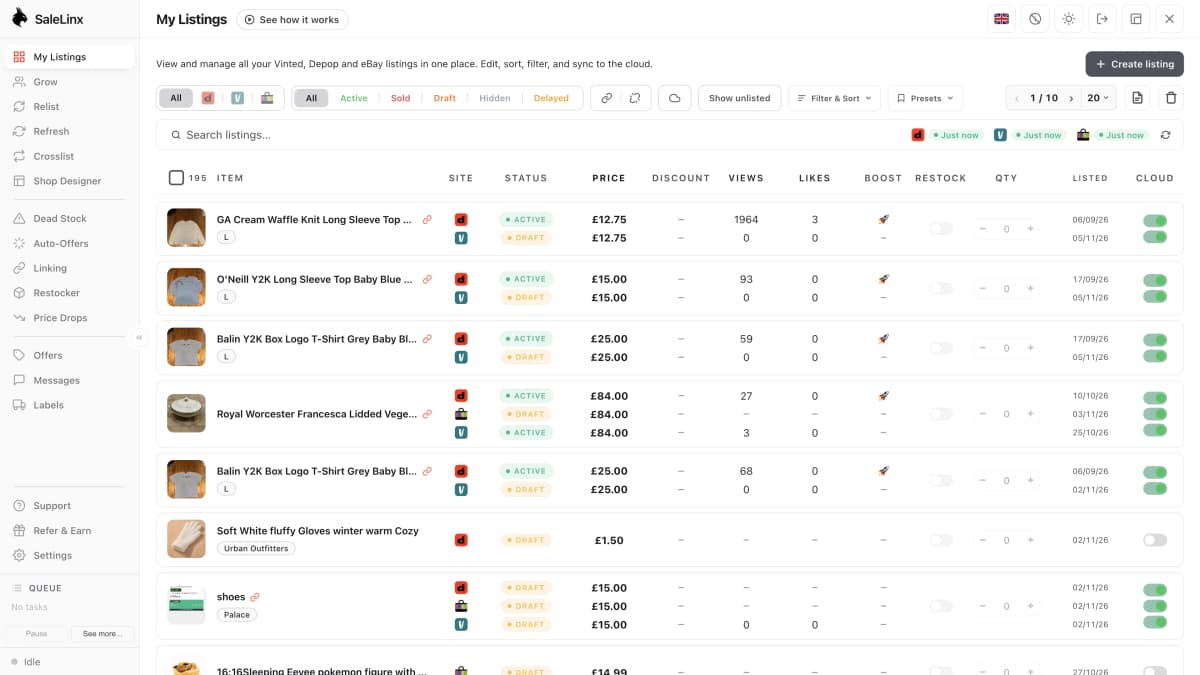
SaleLinx is a Chrome extension for Depop, Vinted and eBay sellers. It is not an accounting tool, it does not work out tax and it will not file anything for you. What it can do is save you opening three accounts to see what you sold.
- My Listings shows your listings from all three marketplaces in one grid, sold items included, so you can see what sold and for how much in one place. Check the totals against each platform’s own records before you use them.
- Cloud sync keeps a copy of a listing’s details and photos in your account after the marketplace stops showing it.
Your receipts for stock and postage are still yours to keep. Vinted’s terms restrict external software tools, so keep what you do on Vinted to what a person would do by hand. From £7.99 a month, with a 14-day free trial.
Try it free for 14 daysQuestions
When is the Self Assessment deadline for Vinted, Depop and eBay sales?
For the 2025 to 2026 tax year (6 April 2025 to 5 April 2026), the online return and any tax owed are both due by 11:59pm on 31 January 2027. The deadline to register was 5 October 2026.
I missed the 5 October registration deadline. What now?
Register as soon as you can. GOV.UK says you could get a penalty, and that HMRC will send a letter or email with a new return deadline three months from its date. The payment deadline stays 31 January 2027.
Can I claim the £1,000 trading allowance and my expenses?
No, it is one or the other. If your sales are over £1,000, work out your tax both ways and claim whichever leaves less to tax. Costs above £1,000 usually make expenses the better choice.
Is the figure Vinted or Depop sends to HMRC my turnover?
Not necessarily. The report covers the calendar year, not the tax year, and shows earnings after fees. GOV.UK says it does not replace your own records, so work out your income for 6 April to 5 April yourself.
How long do I keep my records?
At least 5 years after the 31 January submission deadline. For the 2025 to 2026 return that is until at least 31 January 2032.
What happens if I cannot pay the full bill by 31 January?
File on time anyway, because a late return has its own penalty. Unpaid tax then attracts interest and a 5% penalty at 30 days, 6 months and 12 months, so pay what you can by the deadline.